
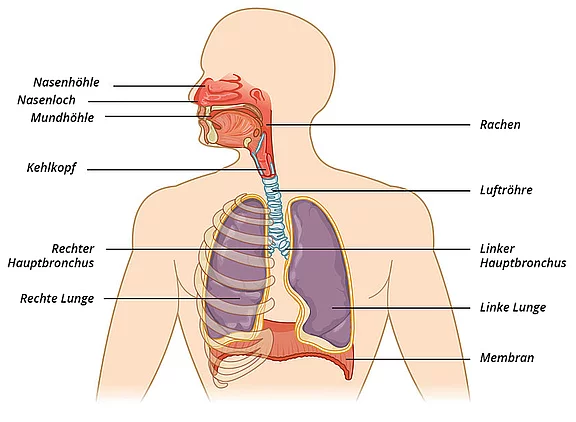
Our voice is as unique as a fingerprint. We use it to express our joy, sadness and fear. We speak a total of 16,000 words a day. For most people, this is a completely everyday activity that demands high performance from our bodies. There are basically three different functional areas: breathing, the vocal cords with the larynx, and the mouth, throat and nasal cavities as resonance chambers.
Anatomical process
Simply put, our vocal cords are set into vibration by the air we exhale, and the resulting sound is amplified in the mouth, throat and nasal cavity. The vocal cords are located in the larynx, which forms the upper part of our windpipe. Our vocal cords consist of fine skin that is tensed and relaxed by muscles.
During normal breathing, the glottis between the vocal cords is wide open and the muscles are relaxed. In order to produce sounds, the vocal cords are tensed. This makes the glottis much smaller and the air flowing through it causes the vocal cords to vibrate. You can imagine this as plucking the strings of a guitar. The more relaxed the vocal cords are, the deeper the sound. The more they are tensed, the higher the sound. Our vocal cords are only responsible for the pitch and volume of the sound. The actual sound formation, or articulation, takes place in the mouth, throat and nasal cavity. The tongue, teeth and lips also play an important role in sound formation.
Where do deep and high voices come from?
The pitch depends not only on the tension and relaxation of the vocal cords, but also on their thickness and length. The thicker and longer the vocal cords, the deeper the voice. Men generally have longer vocal cords than women because their larynx is also considerably larger.
The development of the voice
At first, all children have very high voices, as the vocal cords are similarly short in both sexes. It is only from the age of 6 that the pitches begin to differ. During puberty, hormonal changes cause the larynx to grow. This also makes the voice deeper. During this time, boys in particular have problems controlling their changing vocal cords. This results in an uncontrolled switch between a male and a childish voice.
In adults, the pitch of the voice remains very stable. Hormonal changes can sometimes cause voice impairments in women. This is particularly common before or during menstruation, during pregnancy and during the menopause.
Later, around the age of 60, age-related changes occur in the body that also affect the voice. In women, voices usually become deeper during menopause, while in men, voices become higher with age.
It is important to distinguish between normal voice changes associated with ageing and a diseased or disordered ageing voice. If you experience problems or a sudden change in your voice, please do not hesitate to contact us.
Make an appointment with us today!
Your Logolo practice team