
Adults can also experience language, speech, swallowing and voice disorders, for example due to aphasia caused by damage to areas of the brain. In a speech therapy practice, exercises are individually tailored to the patient so that their speech and language skills can be restored. Speech impairments in adults can be either congenital (e.g. disabilities or syndromes) or acquired ( e.g. tumours, stroke, traumatic brain injury). In adults, we treat speech, language, voice and swallowing disorders of all degrees of severity.
These can be caused by a wide variety of underlying conditions. The aim of therapy with adults is to address specific deficits through therapy that is relevant to everyday life. The focus is on individual potential, which is used as a basis for developing skills and providing therapeutic support for functions and activities to achieve the best possible physiology, thereby alleviating limitations and improving quality of life and participation.
Aphasia refers to language problems that have a neurological cause. Aphasia manifests itself in varying degrees of severity in speech production disorders and/or speech comprehension disorders. People who have a speech production disorder use many filler words or phrases such as "um" or "thing, you know...". This often leads to interrupted sentences.
People with a language comprehension disorder often express themselves in extremely long, word-rich sentences, which are usually lacking in content. A language production disorder can be so severe that only certain words or phrases are uttered that do not fit the context, but the person affected is aware of this and understands language without difficulty for the most part.
People with a language comprehension disorder no longer understand language, or at least not completely. This can manifest itself in such a way that everyday requests are no longer understood and those affected lose their bearings in everyday life.

Dysarthria or apraxia are speech problems that affect language. In dysarthria, breathing, voice and articulation in the form of muscle movements in the mouth area (tongue, lips, cheeks, etc.) no longer work together harmoniously, making it difficult to understand the affected person due to, for example, a broken voice, limited articulation movements and/or frequent interruptions in speech due to shortness of breath.
Dysarthria can occur in varying degrees of severity and intensity. Thismeans that the affected person may become incomprehensible, even if the dysarthria is very mild and mainly affects articulation. The same is true of apraxia. This can also lead to very incomprehensible speech, although speech comprehension does not necessarily have to be impaired.
In contrast to dysarthria, the muscle groups are no longer controlled correctly by the brain, but breathing, voice and articulation are not impaired. Another neurologically-related area of speech therapy treatment in adults is dysphagia, or swallowing problems. For example, because the muscle groups involved are too weak, sensitivity in the mouth area is reduced and the swallowing reflex is not triggered or is triggered too slowly, or the coordination of chewing, swallowing and breathing is difficult, swallowing disorders often lead to food being swallowed.
Among many other symptoms, affected individuals may frequently clear their throat or cough after eating, chew for a very long time, or have difficulty swallowing. If you suspect a swallowing problem, it is very important to consult a doctor at an early stage, as frequent choking can lead to pneumonia and thus become life-threatening.

Swallowing disorders can be helped with dietary adjustments and targeted exercises tostrengthen the muscles and increase sensitivity. They can manifest themselves in a very mild form, but it can also happen that affected individuals are no longer able to safely consume food. Another area of treatment is voice problems. These can manifest themselves in a hoarse, brittle, quiet voice that is not optimally resilient. Voice disorders can have a functional, organic and/or psychological origin, which often causes those affected to experience strain and tension when speaking, which can also be painful.
Functional means that the voice, as our tool, is not being used optimally. For example, people affected by this condition often have quite shallow breathing, which is the basis for a good voice, and do not use it optimally.
In contrast, it may also be that too much pressure is exerted on the vocal cords, resulting in a very tense, forceful voice. The vocal cords can also be strengthened as muscles, making them more resilient.
We are happy to assist you at any time by telephone or email and would also be delighted to welcome you in person at one of our speech therapy practices in Lichtenberg North, Lichtenberg South, Pankow, Märkisches Viertel or Bernau near Berlin.
Another neurologically-related treatment area in adults is dysphagia, or swallowing problems. This involves frequent choking on food, for example due to reduced sensitivity in the mouth area or weakness in the muscle groups involved. As a result, the swallowing reflex is not triggered or is triggered too slowly, or the coordination of chewing, swallowing and breathing is impaired. Among many other symptoms, affected individuals may frequently clear their throat or cough during or after eating, chew for a very long time or have difficulty swallowing.
We would like to reiterate that if you suspect a swallowing problem, it is very important to consult a doctor at an early stage, as frequent choking can lead to pneumonia and thus become life-threatening.
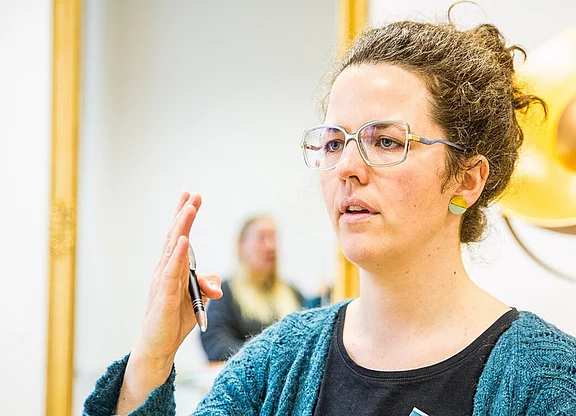
Voice disorders can have functional, organic and/or psychogenic causes. Functional means that breathing, which is the basis for a good voice, is quite shallow and not used optimally. In contrast, it may also be that too much pressure is exerted on the vocal cords, resulting in a very tense, forceful voice. The vocal cords can also be strengthened as muscles, making them more resilient. However, a fundamental component of this therapy is also posture and one's own perception of the body and voice.
These components are also essential in the treatment of organically caused voice problems. Organic underlying conditions can include, for example, paralysis of a vocal fold, a tumour in the larynx area, or an irritated nerve after thyroid surgery. In addition to posture, breathing, voice production and voice perception, compensatory measures are a very important part of compensating for the function of a vocal fold that is no longer active.
Electrical stimulation therapy is very effective for nerve disorders. Psychogenic voice problems should be treated in conjunction with professional psychotherapy in order to address not only the effect, i.e. the voice problem, but also the origin of the voice problem. External and internal accompanying symptoms, such as high stress and insecurity, but also accompanying movements of the face or body, are equally individual.